
← Back to the galleryMaterial X-Change (.MAT)

FROM THE COMMUNITY COLLECTION

Metal512

Made with Bryce

Created by davidbrinnen

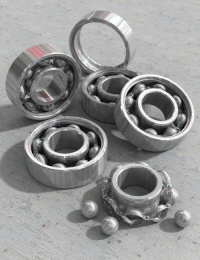
Picture driven metallic effect. Models taken from http://www.daz3d.com/i/shop/itemdetails/?item=11542 including Horo's HDRI backdrop. TA render with scattering correction. This material used for everything, but with reflection set to 0 for ground.

1unique views 10,468unverified legacy hits2.6archived rating2011-11-30added
How views are counted

New views count once per account, or per anonymous browser. Review/private views are not counted. No IP addresses are stored for view counts.

Metal512

Comments (3)

Sign in to join the conversation →

rashadcarter1Archived

- Seems fine. But once again i find myself distracted by the high degree of diffusion. It almost seems less plausible to me because of it. Also, there is something odd with the reflections. it almost looks as if an image is being stretched along the height of the loops. Almost like the reflections are drawn onto the objects instead of being reflected from within the environment. not sure how describe what I am perceiving.

davidbrinnenArchived

- Thanks Rashad, yes perhaps the metal is a little too matt. The drawn effect is down to the limitations of the mapping mode. UV mapping would help for specifics, but other types of generic mapping would not also go amiss. If picture images could be given the same degree of control as procedurals, in other words, be a selectable source in the DTE as well as noise, many novel solutions might open up. But such is a pipe dream. Thanks for your feedback, I'll continue to explore this approach to see what's possible.

rashadcarter1Archived

- Being able to truly integrate procedurals and photos is long overdue for Bryce. I understand that to some degree it is possible to mix them in the Material Lab, however the ability to do so within the DTE would be game changing. It seems like it should be possible to convert the original image into a vector of sorts, that could then be manipulated with functions within the DTE. The problem of resolution comes in. Aside from merely seamlessly tiling, how exactly does one go about transforming a specific image into a procedural capable of potentially infinite variation and resolution? I'm convinced I'm not smart enough to answer that one but hopefully someone out there is. Pipe dreams in my mind as well.